PdmContext
Notice for existing users: what changed in version 0.3.0
No public function or class was removed or renamed, and no parameter was removed or reordered. Existing code keeps working; the notes below list what you may notice.
Check when upgrading
- Installation: gCastle is now an optional dependency. If you use the default causality function
(
calculate_with_pc), install it withpip install PdmContext[pc], which also installs torch (required by gCastle) ([movingpc]for the deprecated MovingPC). ContextGenerator.contextsis now a read-only sequence (indexing, slicing,len, iteration) instead of alist, soappendand item assignment are not available (assigning a whole list still works). A context changed in place after it was returned, and no longer referenced, is not kept with those changes.- NaN values are ignored by
collect_data(as if the sample did not arrive). A NaN target sample returnsNone(no context). Previously a NaN in the window made characterization fail. PdmContext.LightContextGenerationis deprecated (DeprecationWarning). UseContextGenerator(..., characterize_it=False).PdmContext.utils.MovingPCis deprecated (DeprecationWarning, experimental and not stable). Usecalculate_with_pc, optionally withContextGenerator(..., causality_every=k).
Results that change (bug fixes)
- Returned contexts no longer change afterwards (they used to receive values of later samples).
- Categorical sources: no future values in the series, a category sent before the context horizon is kept as active (values may be sent only when they change), no category is active before the first known value.
- The context window contains exactly the samples of the horizon (it had one extra old sample).
- Source names are matched exactly (e.g.
data1no longer includesdata10; a source whose name contains the target name is no longer dropped). - Configuration series start from 0 in each window instead of wrapping around (bounded, without false drops).
- Characterization: isolated events use the event rule, and the continuous rule uses the sum of deltas as documented.
- Late data are placed in time order; the
replacepolicy also works for the first buffered event. simulate_streamno longer skips the first record.
Other fixes and additions
- Memory is bounded for endless streams: stored contexts take about two windows of data per source (it was quadratic in the window), and the buffer is also trimmed when the target stops sending data.
- Faster context generation with the same results: about 2.5x to 4x (larger windows gain more), with or without characterization, not counting the causality discovery itself.
- New, opt-in:
ContextGenerator(..., causality_every=k)runs the causality discovery every k contexts and reuses the last edges in between (default 1: unchanged). - New, opt-in:
ContextGeneratorBatch.generate_contexts(timestamps, n_jobs=1)generates many contexts, in parallel processes whenn_jobs > 1. - NumPy 2 and pandas 3 support,
distances.PCA_precaching, defaultDBscanContextStreamdistance. - The Pipelines classes accept the
replacepolicy;empty_causeacceptstimestamps. - SQLite field names are validated and InfluxDB query values escaped.
- Test suite, including tests with the real PC (
pip install PdmContext[test,pc],python -m pytest).
Context encapsulates all available multimodal information around a target signal (usually anomaly scores), towards better anomaly detection and predictive maintenance solutions.
A context represents the data observed in a time window (the context horizon), mapped from their multimodal form (sensor values, events, configuration changes, categorical states) to a multivariate time series (CD), and the relationships between them (CR), extracted with causal discovery.
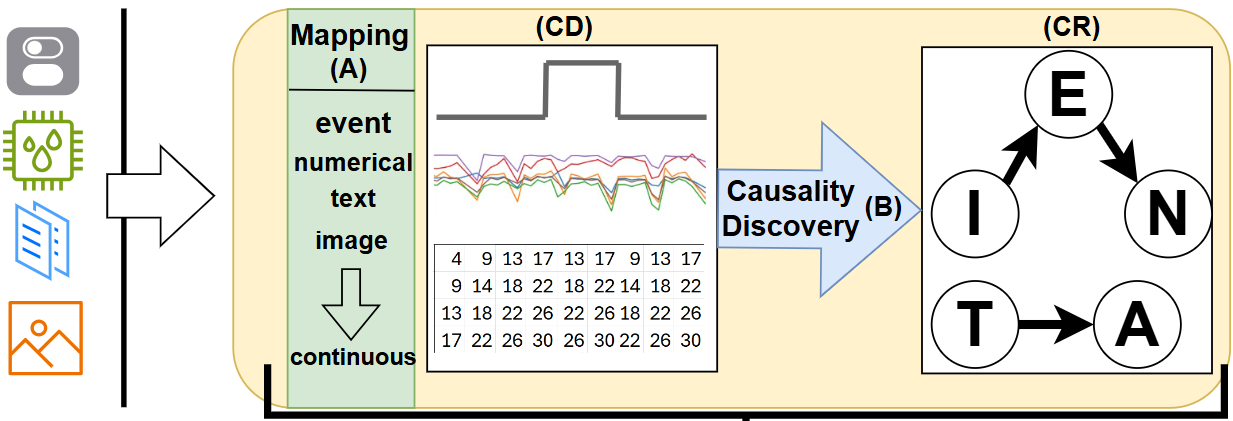
Context generation is an online process: data are collected as they arrive, and each new value of the target series creates a new context.
Installation
pip install PdmContext
The causality discovery method is pluggable. Optional dependencies:
pip install PdmContext[pc]        # gCastle PC (and torch), used by the default causality function
pip install PdmContext[movingpc]  # deprecated MovingPC (gCastle + scipy)
pip install PdmContext[pca]       # PCA based context distance (scikit-learn)
pip install PdmContext[influxdb]  # InfluxDB storage
Quick start
import pandas as pd
from PdmContext.ContextGeneration import ContextGenerator
from PdmContext.utils.causal_discovery_functions import calculate_with_pc

con_gen = ContextGenerator(target="anomaly scores", context_horizon="8 hours", Causalityfunct=calculate_with_pc)

t = pd.Timestamp("2024-01-01 10:00")
con_gen.collect_data(timestamp=t, source="Machine_A", name="temperature", value=40.5)
con_gen.collect_data(timestamp=t, source="Machine_A", name="speed change", type="configuration")

# a sample of the target series creates a context
context = con_gen.collect_data(timestamp=t, source="Machine_A", name="anomaly scores", value=0.3)

context.CD   # {"anomaly scores": [...], "temperature@Machine_A": [...], "speed change@Machine_A": [...]}
context.CR   # {"edges": [...], "characterization": [...], "interpretation": [...]}
Continue with Concepts and Generating context.