Concepts
Target and sources
- Target: the series the context is built for, usually the anomaly scores of a detector. Every new target sample creates a context, and the target defines the sample rate of the context.
- Sources: every other series (sensors, events, configuration changes, categorical states). Each sample is
identified by its
nameandsource; in a context it appears asname@source.
Context horizon
The time window used to build each context, e.g. "8 hours" (units: seconds, minutes, hours, days; a
plain number means hours). A context at time t contains the samples in [t - horizon, t].
The Context object
Context has:
- timestamp: the time of the target sample which created it.
- CD (context data): a dictionary
name -> series, all series with the same length as the target series (one value per target sample in the horizon). A source without data in the window hasNone. - CR (context relationships): a dictionary with
edges: list of(cause, effect)pairs found by the causality discovery function,characterization: a parallel list withincrease,decreaseorunknownfor each edge,interpretation: list of(cause, target, characterization, timestamp), the edges which explain the target, ordered by the time they first appeared.
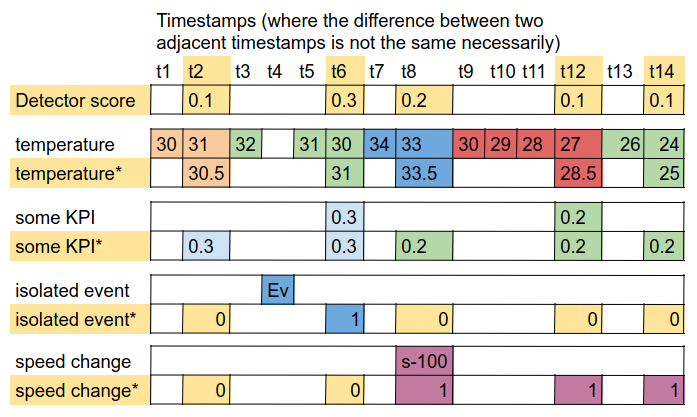
Source types
The type of a source defines how its samples become a series aligned with the target (see
Mapping functions):
| type | meaning | series |
|---|---|---|
Univariate |
continuous values | values aligned to the target sample rate |
isolated |
events with instant impact | 1 at the event, 0 elsewhere |
configuration |
events with a lasting impact | +1 after each event |
categorical |
a categorical state | one 0/1 series per category, and a state series |